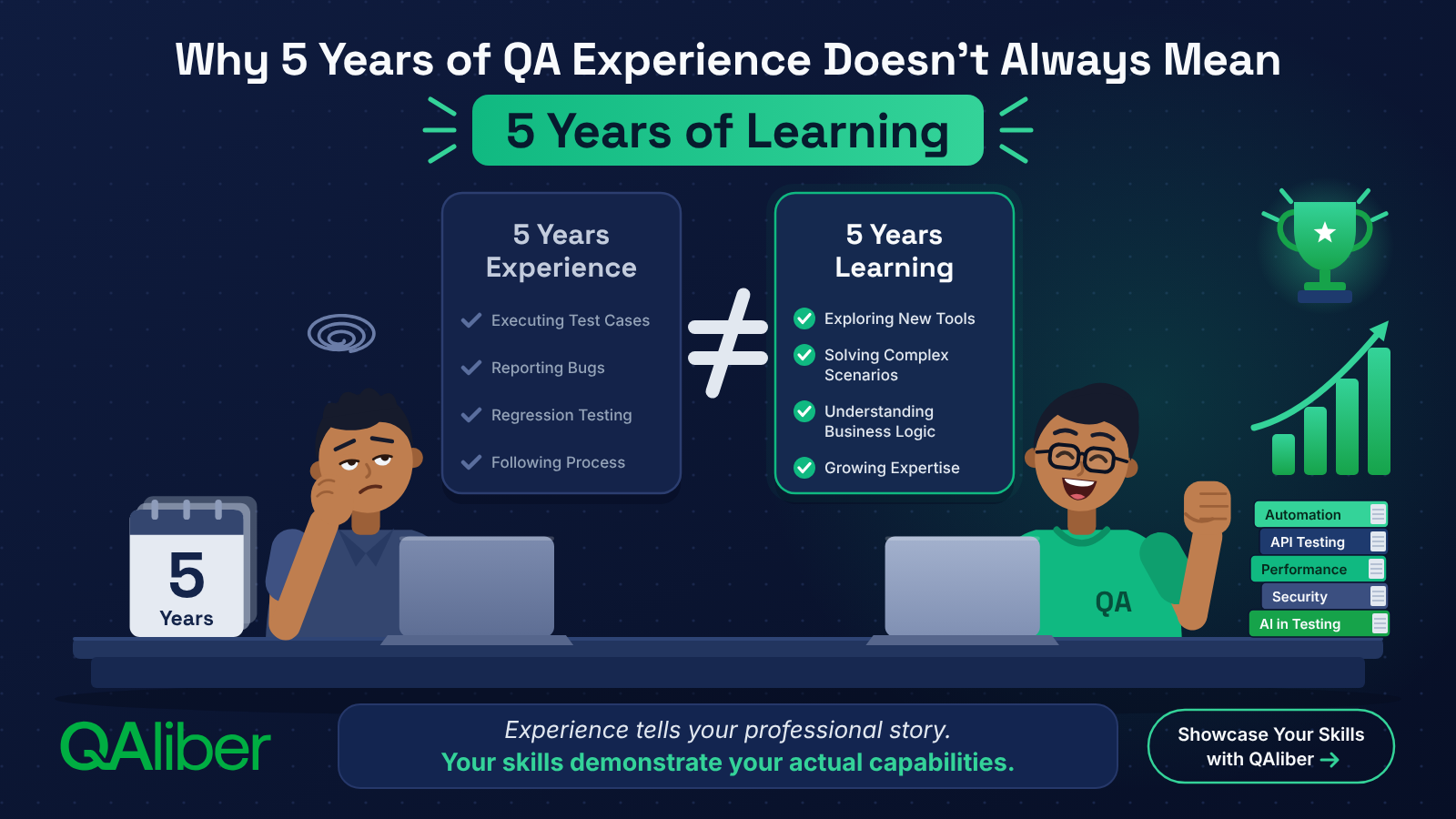
Experience is measured in years, but expertise is built through continuous learning, practical exposure, and problem-solving.
In software testing, experience is often one of the first things recruiters look at when evaluating a candidate. A job description might ask for 3, 5, or even 8 years of QA experience.
But does spending five years in software testing automatically make someone a better QA engineer?
Not necessarily.
A tester can spend five years executing similar test cases, following the same processes, and working with familiar tools without significantly improving their capabilities.
Meanwhile, another tester with just two years of experience might have worked across multiple domains, explored automation, performed API testing, handled complex scenarios, and developed strong analytical skills.
The difference is not simply the number of years. It is what you learn and how you apply that knowledge.
1. Repeating the Same Work Is Not the Same as Growing
One of the biggest challenges in a QA career is becoming comfortable with repetitive tasks.
For example, a tester might spend years:
- Executing predefined test cases.
- Reporting straightforward bugs.
- Performing the same regression cycles.
- Following existing testing documentation.
These activities are important, but professional growth requires going beyond assigned responsibilities.
A good QA engineer doesn't just ask, "Does this feature work?"
They also ask:
- What could go wrong?
- What scenarios have we missed?
- How might users misuse this feature?
- What happens when multiple conditions occur together?
This shift from execution to critical thinking is what develops stronger testing skills.
2. What Actually Makes a QA Engineer Better?
Professional growth in software testing comes from developing a combination of technical and analytical capabilities.
Understanding Business Logic
Testing is not just about validating requirements. Understanding why a feature exists helps testers identify scenarios that might not be documented.
Developing Problem-Solving Skills
Experienced testers learn to think beyond happy paths and identify edge cases, unexpected inputs, and complex user journeys.
Learning New Technologies
Modern QA professionals should continuously explore automation frameworks, API testing, performance testing, security testing, and AI-assisted testing.
Taking Ownership of Quality
A QA engineer should contribute throughout the development lifecycle rather than treating testing as the final step before release.
Learning from Different Domains
Testing an e-commerce platform, a banking application, and a healthcare product requires different approaches and business understanding. Exposure to different products broadens testing knowledge.
3. Experience vs Capability: What Is the Real Difference?
Consider two QA professionals.
Tester A — 5 years experience
- Testing approach: Mostly repetitive
- Test scenarios: Follows requirements
- Technical skills: Limited tools
- Problem-solving: Task-oriented
- Learning: Mostly routine
Tester B — 2 years experience
- Testing approach: Exploratory and analytical
- Test scenarios: Identifies missing scenarios
- Technical skills: Manual, API and automation
- Problem-solving: Business-oriented
- Learning: Continuous improvement
This is a hypothetical comparison, but it highlights an important point.
Years of experience provide exposure. The ability to learn, adapt, and solve problems determines how effectively that exposure translates into professional capability.
This doesn't mean fewer years of experience are better. It means experience should be evaluated alongside demonstrated skills.
4. How Can QA Engineers Make Every Year Count?
If you want to grow in your QA career, consider making these habits part of your professional routine.
- Challenge yourself: Don't stop at executing assigned test cases. Look for scenarios that might have been missed.
- Learn one new skill at a time: Explore tools and technologies relevant to your career goals.
- Practice real-world problems: Work on practical testing exercises instead of relying entirely on theoretical knowledge.
- Share your knowledge: Participate in technical discussions and learn from other QA professionals.
- Track your progress: Document the challenges you have solved, tools you have learned, and improvements you have made.
Small, consistent improvements can make a significant difference over time.
5. Why Demonstrating Your Skills Matters More Than Ever
The software testing industry is evolving. Automation, AI-powered tools, and changing development practices are transforming the expectations from QA professionals.
Recruiters and organizations increasingly need to understand not just how long someone has worked in testing, but what they can actually contribute.
A resume can communicate job titles, responsibilities, and years of experience. But practical challenges, technical contributions, and problem-solving exercises can provide additional evidence of someone's capabilities.
This is why building a visible record of your skills is becoming increasingly valuable.
Final Thoughts
Five years in software testing should ideally represent five years of learning, experimentation, and improvement.
Don't measure your QA career only by the number of years you have completed. Measure it by the problems you can solve today that you couldn't solve a year ago.
Experience tells your professional story. Your skills demonstrate your actual capabilities.
At QAliber, we believe every QA professional should have an opportunity to demonstrate their knowledge, solve practical challenges, and build a credible professional identity.
Because your QA skills deserve to be visible.